
The Book of Voices
Jane Burn is an independent scholar and hybrid practitioner. She is a person with autism, hypermobile Ehlers-Danlos syndrome, PoTS and Fibromyalgia. Existence at intersections between creativity and disability have drawn her into myriad approaches to the gathering and creative presentation of research. Her two most recent poetry collections, Be Feared and The Apothecary of Flight are published by Nine Arches. Foregrounding and backgrounding between the human and more-than-human remains both a constant challenge and a source of infinite fascination to her. Jane’s output slithers, skews and leaps between methods, genres, subject matter and materials – her mind remains at these numerous intersections, thriving in (or perhaps becoming hopelessly entangled in) what seems to be a continuous ten-way dialogue.
‘The Book of Voices’ is the result of an online research group I participated in last year for a couple of months. The group entered into a series of amazing, thought-provoking workshops facilitated by two brilliant academics, Katherine Collins and Joanna Wheeler, who are both much engaged with story making, and the ‘telling’ of non-human stories in varied, non-traditional and hybrid ways. I applied for a place on this course after presenting a research paper, concerning a relatively unknown part of a segment of Antarctica’s history (specifically what is known as the ‘heroic age’ of Antarctic exploration at the conference ‘More-than-human Story-making’ in June 2025, also hosted by Katherine and Joanna.
If the Aurora Australis was the first book made in Antarctica, could I attempt a remake/rewrite of this incredible item while embracing a more non-human mindset, while never having been to the place in a physical sense? And could the book I make contain only traces, hints and fragments? In the same way as the men on Shackleton’s expedition had their voices included, could I do the same for the time, history, landscape and nature? I couldn’t redact my humanness, or remove human manufacture or craft, but I could step away from human words, find other means of expression. Who knows in the end how successful we ever manage to be in our endeavours? If I try, and keep trying, perhaps I might one day locate a satisfactory answer, or I will just keep banking the experiences and allow them to change and inform me and my practice in whatever way they see fit.
Over many, many weeks, the Book of Voices developed. I felt strongly that it could only be made from recycled materials – it always feels wrong to me to add to the burden of the world, though this is one of our human-inescapable things. The book became an expression of passion, overwhelming passion; it became an outflow of raw creativity. It wasn’t about ‘neatness’, or ‘finishedness’, chronological ordering or even making any sort of sense, in the way some humans might imagine sense ought to be. It was about reactions, sensations, and an emotional responding to varied Antarctic data. This is only one volume – an endless number of these could be made, so huge is the potential gathering of notions, facts and natural/human histories connected to this continent.
Poems worked alongside the construction of the pages as different aspects and concepts drifted in and out of my mind. I found it beneficial to ‘empty’ myself of human words through the writing of the poems, leaving me freer to drift into more-than-human states of consciousness. One example of this multiplication of thought, voice and physical manifestation is this poem about human naming of the continent, and the subsequent artwork –
i
Antarktikos
was Aristotle’s logical deduction
a mass which had to exist, in order to balance the Earth
an antipode
to the known north
which Marinus of Tyre’s maps spoke of as Antarctic
Te tai-uka-a-pia
Ūi Te Rangiora sailed the Te Ivi o Atea
to a place of darkness
where the sun did not go,
white as arrowroot
Terra Australis Incognita
in a world divided up with portolan lines
somewhere in the windrose network
an Unknown Southern Land
plotted upon vellum, a hypothetical place
a speculation
which Piri Reis sketched as a place of ruin,
probably with snakes
Antarctica
John George Bartholomew wrote the word by hand
over his map of the continent
in large letters
in blood-red pen
having already toyed with the name Antipodea
in lightly sketched pencil
which can still be traced
a place apparently nameless
until then
let to the deconstruction of a contemporary map of Antarctica and the dissolving of human letters here, as if the land would deny such a claiming through language and cartography –
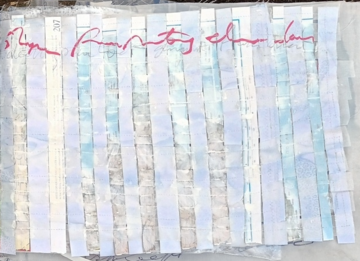
The book then asked for further dismantlement of the relationship between word, map and landscape. Ink became an aurora-like diffusion caught amongst and yet escaping lines of latitude and longitude. We believe the human can hold the more-than-human – we build our grids and print the shape of the world onto paper, before imagining we control and define it. The more-than-human is a morphology we cannot absolutely map. Hints, traces, fragments, signs and codes remain edges we can only nibble at, provide endless kindling for the imagination.
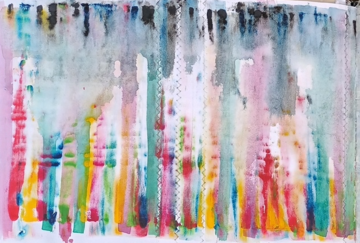
Antarctica and its more-than-humanness is addictive in its evasiveness, forever slipping from our grasp. Its atemporality (in the way that humans define time), its myriad layers of undiscovered mystery, its naturally evolved immunities against us, its turbulent landscape and its elemental forcefields are its elusive superpowers – the greatest part of me hopes that humans never discover how to access them, harness them for profit. Antarctica, with its wonderful, awesome ability to constantly fight against human occupation seems one of Earth’s last bastions, a living, perplexing embodiment of the more-than-human – one of the Last Great Lacunas. Perhaps this is why it has fascinated and drawn humanity toward it for so long. Our territorial division of its acres, our constant acquisition of its secrets have a futility about them which stretches somewhere beyond our understanding.
Cite: Burn, Jane (2026). The Book of Voices. University of Oxford. Media. https://doi.org/10.25446/oxford.32084283.v1

